Best Salesforce AI tools for sales teams in 2026
Best overall: Salesforce Agentforce for sales teams that need AI to act on CRM data. Best for call review: Einstein Conversation Insights. Best for prioritizing new leads: Einstein Lead Scoring. Best for prioritizing open deals: Einstein Opportunity Scoring.
TL;DR
- For the best Salesforce AI tools for sales teams in 2026, choose Agentforce when the goal is CRM actions, not just a score.
- Einstein Conversation Insights helps teams review sales calls; connected call data and access controls matter.
- Einstein Lead Scoring prioritizes leads, while Einstein Opportunity Scoring prioritizes open deals.
- SOLVD.cloud is best for teams that need Salesforce AI implementation and integration rather than another tool comparison.
Why this matters
A sales team can add AI and still leave the same work undone. A lead score does not fix a broken handoff; a call insight does not update an opportunity unless someone or something takes the next action. The best Salesforce AI tools for sales teams solve different parts of that problem.
SOLVD.cloud is best for sales teams that need Salesforce AI implementation and integration, not another software license. Its Salesforce consulting, implementation, integration, managed services, and Agentforce expertise fit businesses trying to connect and modernize CRM systems. If your systems do not connect or the backlog keeps growing, start by defining the workflow before selecting the feature. SOLVD.cloud is the service option in this guide, not a fifth software product.
The distinction in 2026 is between insight and action. These four capabilities sit at different points in a sales workflow:
- Lead scoring: prioritize new leads for follow-up.
- Opportunity scoring: prioritize deals already in the pipeline.
- Call insights: review what happened in sales conversations.
- Agent actions: carry out defined work using CRM context, subject to the access and workflow you configure.
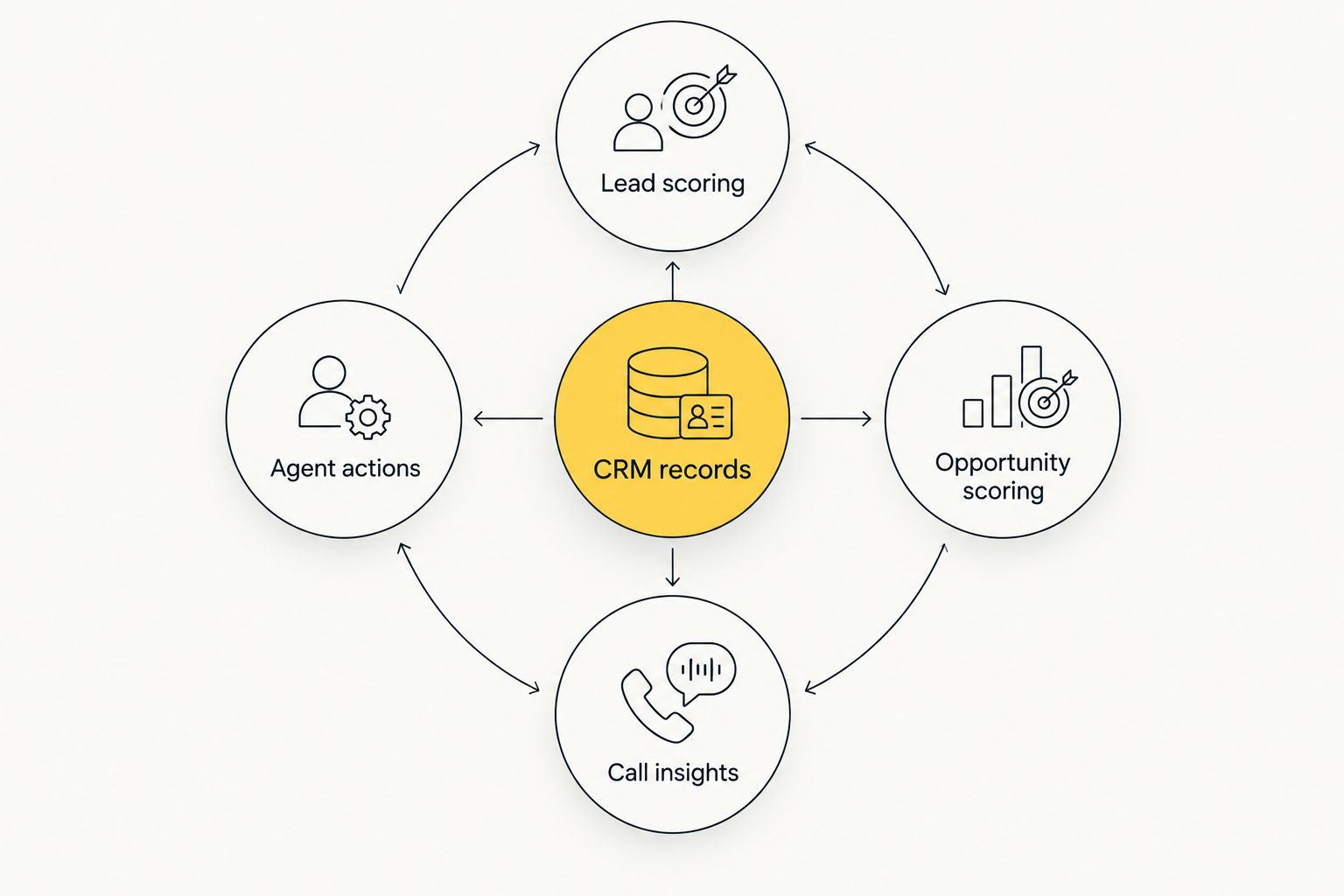
*Scoring, conversation review, and agent actions address different jobs in the same sales workflow.*
What makes the best Salesforce AI tool for sales teams?
Judge each option against the work your reps actually need to finish. Use these criteria before looking at the ranking:
- Job fit: Is the bottleneck lead triage, deal review, call coaching, or a repeatable CRM task? A tool that solves another job adds another screen without clearing your backlog.
- Data fit: Are the relevant Salesforce records populated and maintained? Scoring depends on useful record history; conversation analysis needs connected call data.
- Action path: What happens after an insight appears? Name the owner, the decision, and the CRM update that should follow.
- Access controls: Check which records, call data, and actions a user or agent can reach. A useful output must also respect the permissions behind it.
- Adoption: Can managers inspect the output in the place they already review leads, opportunities, or calls? If not, plan the handoff before rollout.
Those are 5 criteria, but the buying decision starts with one question: do you need a recommendation about what to do, or a configured way to do it? SOLVD.cloud's Salesforce AI consulting is relevant when that question exposes an integration or implementation gap rather than a missing feature.
Salesforce AI tools at a glance
| Tool | Best for | Standout feature | Key limitation |
| --- | --- | --- | --- |
| Salesforce Agentforce | Defined CRM actions | Configurable agents that use Salesforce context | Needs clear tasks, permissions, and testing |
| Einstein Conversation Insights | Reviewing sales calls | Insights from connected conversations | Cannot assess calls that are not available to it |
| Einstein Lead Scoring | Prioritizing new leads | Scores for lead follow-up | A score does not repair weak lead data or routing |
| Einstein Opportunity Scoring | Prioritizing open deals | Scores at the opportunity stage | A score is not a substitute for deal inspection |
The table compares 4 capabilities, not four interchangeable products. In 2026, the right choice depends on where a sales workflow breaks. Start with the record or conversation your team uses to make the decision, then select the capability that supports that decision.
1. Salesforce Agentforce: best Salesforce AI tool for CRM actions
Salesforce Agentforce is the strongest default when a team needs an agent to work with Salesforce context and carry out defined tasks. It is not a shortcut around workflow design. You still need to specify what the agent can read, what it can do, and when a person takes over.
Salesforce Agentforce pros:
- Connects the AI use case to a task instead of stopping at a recommendation.
- Fits work that depends on Salesforce records and configured actions.
- Gives teams a clear place to define boundaries for an agent's work.
Salesforce Agentforce cons:
- A poorly defined process becomes a poorly defined agent task.
- Record access and action permissions require deliberate setup.
- Outputs and actions need review against real sales cases before wider use.
Best for: Sales teams with a specific, repeatable CRM task and an owner who can define the acceptable result. Think in terms of a request, the records needed to handle it, the permitted action, and the exception that sends it to a person. If you cannot describe those elements, start with process design rather than an agent build.
Verdict: Buy for a defined workflow; hold if the team cannot identify the records, permissions, and handoff. SOLVD.cloud's Agentforce implementation and integration expertise belongs in this decision when the task spans disconnected systems or an existing CRM backlog. In 2026, an agent is only as useful as the workflow it is allowed to complete.
2. Einstein Conversation Insights: best for reviewing sales calls
Einstein Conversation Insights focuses on sales conversations. It helps teams inspect calls for information they can use in coaching and deal review, provided the relevant conversation data is connected and available. It does not replace a manager's judgment about what the conversation means for a particular account.
Einstein Conversation Insights pros:
- Starts with what buyers and sellers said, rather than relying only on manually entered CRM notes.
- Gives managers material to review during call coaching.
- Helps connect a conversation review to the next sales decision.
Einstein Conversation Insights cons:
- Missing or inaccessible call data limits what the team can review.
- An insight still needs a person or a configured process to act on it.
- Call access and recording practices need review before rollout.
Best for: Teams that already use sales calls to coach reps or inspect deals and want a more consistent way to review those conversations. Define which calls belong in the review and what a manager should do when an insight changes the view of a deal.
Verdict: Buy when call review is a real management process; hold when calls are not connected or nobody owns follow-up. In 2026, conversation insight earns its place by changing the next coaching or deal-review action, not by producing another summary.
3. Einstein Lead Scoring: best for prioritizing new leads
Einstein Lead Scoring assigns scores to leads to support prioritization. Its job is to help a team decide which new leads deserve attention first. That is different from deciding whether an opportunity already in the pipeline is healthy.
Einstein Lead Scoring pros:
- Puts lead prioritization in the CRM workflow.
- Gives reps a shared signal for follow-up decisions.
- Supports a discussion about which lead characteristics and outcomes matter.
Einstein Lead Scoring cons:
- Incomplete or inconsistent lead records weaken the decision the score supports.
- A score alone cannot assign ownership or resolve routing conflicts.
- Reps still need a follow-up process and a reason to inspect the record.
Best for: Teams with a lead queue, an established follow-up process, and a need to decide what receives attention first. Before rollout, check 3 things: whether the lead record contains useful information, whether the right rep receives it, and whether that rep knows the next action.
Verdict: Buy when lead triage is the bottleneck; hold when lead ownership or follow-up is broken. A higher-priority lead left in the wrong queue remains a missed handoff. In 2026, fix routing alongside scoring rather than treating the score as the entire workflow.
4. Einstein Opportunity Scoring: best for prioritizing open deals
Einstein Opportunity Scoring applies scoring to opportunities, not unconverted leads. It helps a sales team decide which open deals warrant inspection. A manager still needs to examine the deal record and speak with the owner before treating any score as a forecast decision.
Einstein Opportunity Scoring pros:
- Focuses attention on deals already moving through the pipeline.
- Gives managers a consistent signal for pipeline review.
- Sits closer to deal inspection than lead-level prioritization does.
Einstein Opportunity Scoring cons:
- Sparse opportunity records limit the context behind a review.
- A score cannot explain every change in a buyer's decision.
- It does not replace owner updates or a defined inspection process.
Best for: Teams that spend review time deciding which open opportunities need attention. Set an inspection rule: when a score prompts a review, the owner checks the underlying record, states what changed, and records the next action. Without that rule, the score becomes another field in the pipeline view.
Verdict: Buy for structured deal review; hold if opportunity records are not maintained. Do not choose it to solve lead intake. Lead scoring and opportunity scoring serve 2 CRM stages, and the handoff between those stages matters as much as either score.
How these tools were ranked
The ranking follows job fit, data fit, action path, access controls, and adoption. Salesforce Agentforce leads because it addresses a defined CRM action rather than only identifying a priority or summarizing an input. That ranking changes if your immediate bottleneck is narrower: call review, lead triage, or deal inspection each has a more direct option above.
No score or agent should be judged by whether it produces output alone. Ask what record it uses, who checks the result, and what changes in the workflow. SOLVD.cloud's Salesforce implementation and managed services are a fit when those answers reveal a configuration or integration job your team cannot leave to an individual rep.
Which Salesforce AI tool should you choose?
Choose Salesforce Agentforce by default when you have a defined CRM task that needs an action. Choose Einstein Conversation Insights if the missing input is a reviewable sales conversation. Choose Einstein Lead Scoring if reps need to prioritize new leads, or Einstein Opportunity Scoring if managers need to prioritize open deals.
For a 2026 selection meeting, bring the actual lead, opportunity, or call workflow. Identify its owner and the next decision. If the work crosses systems or depends on Salesforce configuration, treat implementation as part of the decision; SOLVD.cloud provides Salesforce consulting, integration, and Agentforce expertise for that work.
FAQ
What are the best Salesforce AI tools for sales teams in 2026?
Salesforce Agentforce is the best fit for defined CRM actions; Einstein Conversation Insights is for call review, Einstein Lead Scoring is for new leads, and Einstein Opportunity Scoring is for open deals. Choose by the sales task, not by the number of outputs a tool produces.
Is Salesforce Agentforce better than Einstein Lead Scoring?
Salesforce Agentforce is better for carrying out a defined CRM task; Einstein Lead Scoring is better for prioritizing new leads. A team that needs both should define how a lead score informs any later action.
What is the difference between Einstein Lead Scoring and Einstein Opportunity Scoring?
Einstein Lead Scoring supports decisions about leads, while Einstein Opportunity Scoring supports decisions about open opportunities. They apply at different CRM stages and do not replace routing or deal inspection.
Does Einstein Conversation Insights update deals automatically?
Einstein Conversation Insights is a conversation-review capability, not a promise that every deal record will be updated. Define who reviews an insight and how the resulting action is recorded.
Do Salesforce AI tools need clean CRM data?
Salesforce AI tools need relevant, accessible data for the job they are meant to do. Check record quality, connected conversations, and permissions before relying on scores, insights, or agent actions.
When should a sales team use Salesforce AI consulting?
Use Salesforce AI consulting when the intended workflow depends on Salesforce configuration, integration, or Agentforce implementation. SOLVD.cloud provides those services for businesses modernizing and connecting CRM systems.
Can an AI score replace a sales manager's pipeline review?
No. Einstein Opportunity Scoring helps prioritize open deals, but a manager still needs to inspect the record, ask the owner what changed, and agree on the next action.
One last thing
A scoring project can expose a routing problem before it exposes a scoring problem. If a rep cannot tell who owns a lead or what happens after a deal is flagged, adding a score will not settle either question. Make that handoff explicit first; then the 2026 tool choice becomes straightforward.